

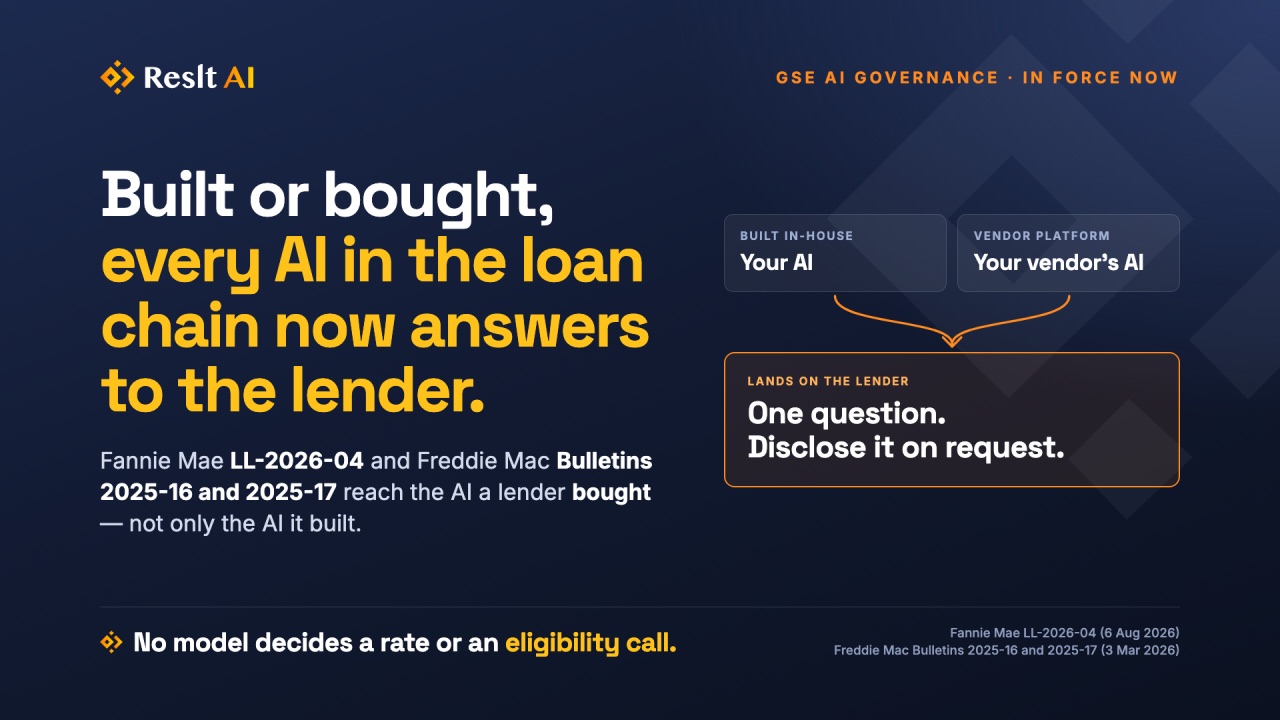
Since 6 August, Fannie Mae’s Lender Letter LL-2026-04 has made lenders responsible for governing their vendors’ AI, not just their own — and requires them, on request, to disclose what AI they use, what for, and how it’s safeguarded.
Freddie Mac got there first. Bulletin 2025-16 put an AI governance framework into the Seller/Servicer Guide, in force since 3 March for origination and servicing alike.
So the question lands on the lender. The answer lives in the software — often software someone else wrote.
I spent eleven years at Freddie Mac. The pattern doesn’t change: a requirement lands on the lender first, then travels down the stack until it becomes the price of being in it.
Three practices that turn the question into a lookup
Three practices turn that question into a lookup instead of a project. None of them are new.
01 · Inventory AI as you build
Record where it sits and what it touches while the code is being written — not months later, from memory.
02 · Keep production deterministic
Let AI do its work at build time and ship reviewable code: same input, same result.
03 · Make evidence a by-product
Policy, provenance and audit trail should fall out of how you build, not get assembled when someone asks.
How we build
That is how we build at Reslt AI, from the first commit. AI accelerates the work; no model decides a rate or an eligibility call. So when the question comes, the answer is already written down.
If this is on your desk this quarter, I’d like to compare notes — get in touch.
Sources: Fannie Mae Lender Letter LL-2026-04 (effective 6 August 2026); Freddie Mac Guide Bulletin 2025-16 (effective 3 March 2026).
Originally published on LinkedIn.
Related: Governance Readiness — AI governance, SOC 2 and privacy · LLM Assurance — testing the AI you build or buy · On-Prem Customized LLM for Mortgage